REFERENCE FILE
Used Gear
Inspect a used telescope, mount, or binocular without relying on a listing description.
Start with the useful answer
Inspect a used telescope, mount, or binocular without relying on a listing description. The field decision is not to chase a perfect result. It is to choose a target and a setup that fit the sky, the time available, and the instrument already at hand.
What changes the result
Brightness, field of view, stability, transparency, seeing, Moonlight, and your own dark adaptation do not move together. Treat them as conditions to notice, not as a single score. A larger instrument can help, but it cannot remove haze, vibration, or an obstructed horizon.
A field method
Begin with the lowest practical power or widest practical field. Confirm the target, make one adjustment at a time, then write down what changed. This approach makes a short session repeatable and gives you a cleaner reason for the next upgrade, if one is needed.
Where the record helps
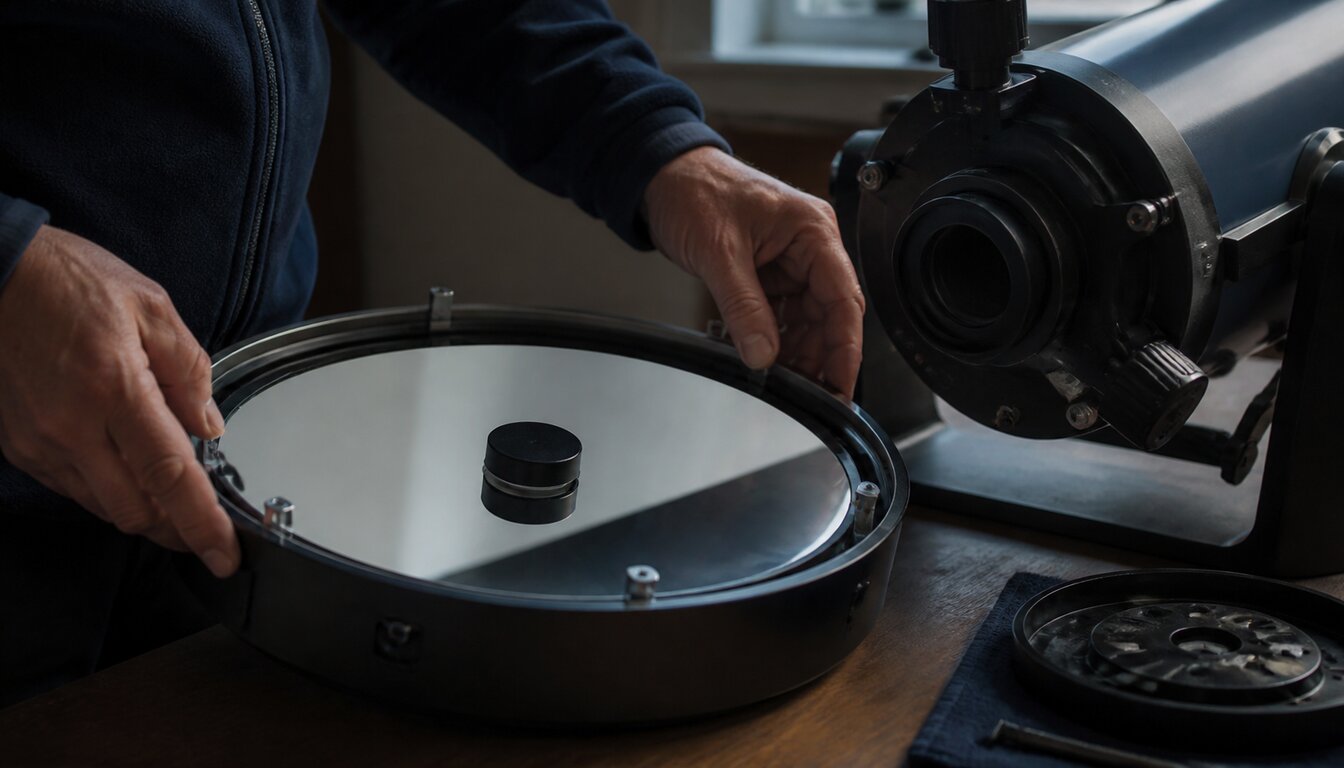
The Field Index connects target type, broad season, simplest useful instrument, and sky sensitivity. Its labels are editorial guidance, not visibility guarantees. For methods and source limits, read the methodology before treating a compact table as a promise. Optics and clothing fail in similar ways. A listing describes condition; the object shows it. Check the focuser for play, the mirror for coating loss, the hinge for stiffness. Then apply the same test to what you wear in the field: fewer pieces, known fibres, real climate, longer use. That is the method set out in responsible dress in practice, which covers fibre choice, wardrobe size, washing less, and visible mending. A mount that holds collimation and a jacket that survives dew both reward inspection before purchase, not after.
Inspection rewards the same discipline as any measurement routine: check the item, record what you see, and compare it against a known standard. A used mount with smooth axes and no play is like a grinder that holds a consistent particle size, both are tools where small variations decide the result. If you want a model for how to read a label and judge condition before you commit, the guide at astrosights.com on a reference for roast dates walks through reading dates, spotting faults, and deciding whether a batch can be corrected. Apply that same eye to glass, coatings, and focuser travel before you buy.
Source note. Practical context is checked against the primary and specialist records in our source register, then bounded by the methods recorded on the methodology page.