FIELD GUIDE
Moon Observing
The terminator turns a familiar object into a reliable first-night laboratory.
Start with the useful answer
The terminator turns a familiar object into a reliable first-night laboratory. The field decision is not to chase a perfect result. It is to choose a target and a setup that fit the sky, the time available, and the instrument already at hand.
What changes the result
Brightness, field of view, stability, transparency, seeing, Moonlight, and your own dark adaptation do not move together. Treat them as conditions to notice, not as a single score. A larger instrument can help, but it cannot remove haze, vibration, or an obstructed horizon.
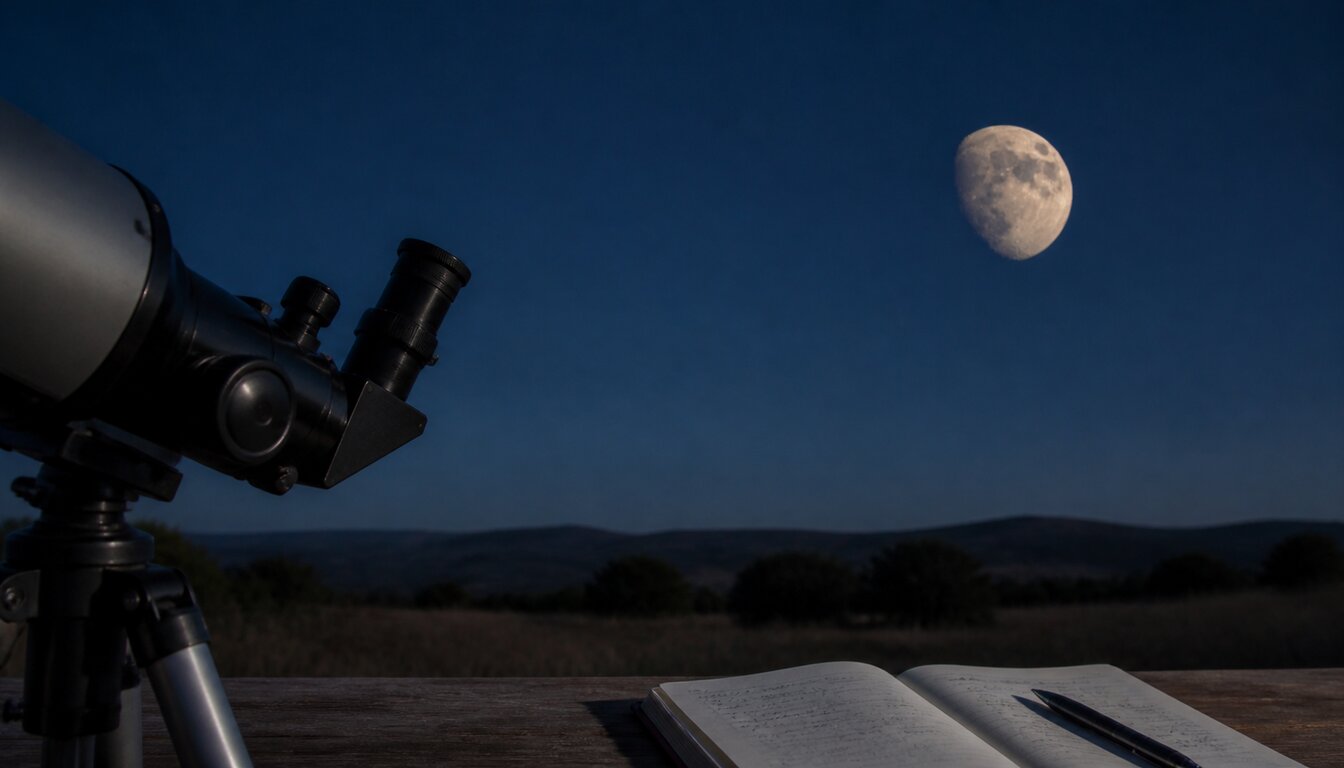
A field method
Begin with the lowest practical power or widest practical field. Confirm the target, make one adjustment at a time, then write down what changed. This approach makes a short session repeatable and gives you a cleaner reason for the next upgrade, if one is needed.
Where the record helps
The Field Index connects target type, broad season, simplest useful instrument, and sky sensitivity. Its labels are editorial guidance, not visibility guarantees. For methods and source limits, read the methodology before treating a compact table as a promise. The Moon is the fast calendar in the sky, and the slower calendar of the year explains the four dates that sit between the solstices and the equinoxes.
The same patience that makes the terminator readable applies to other first looks. A first single by an independent band is often recorded in one room, mixed by the players, and released without a label behind it. Listeners who want to follow that work can start with local venues and small shows, where the distance between performer and audience is short. A guide to starting a record collection covers first singles, local scenes, and what to notice in an album, with no hype. The method matches the one used here: observe closely, record what you see, and return on another night.
The same discipline that makes a terminator sketch repeatable applies away from the eyepiece. A shared home computer rewards the same habits: separate accounts, a backup routine, a written maintenance log. A guide on teaching Windows upkeep treats those tasks as practical skills for students and families, covering account separation, hardware care, and privacy settings. The approach mirrors an observing log. Record what changed, when, and why, and the machine stays usable for years rather than months.
Source note. Practical context is checked against the primary and specialist records in our source register, then bounded by the methods recorded on the methodology page.
Reviewed sights at a glance
| Sight | Start with | Sky band | Broad season |
|---|---|---|---|
| Moon | naked eye to small telescope | urban-bright | all year |
| Pleiades | naked eye or binoculars | suburban | autumn to winter |
| Orion Nebula | binoculars or telescope | suburban | winter |
| Andromeda Galaxy | binoculars | dark-sky favored | autumn |
| Jupiter | small telescope | urban-bright | seasonal |
| Saturn | small telescope | suburban | seasonal |
Each record asks a practical question: what is the simplest useful view, and which condition is most likely to change it? The table is a starting point for planning, not a live sky forecast.