FIELD GUIDE
Sky Charts Before the Web
Clubs traded charts, planet positions and star party dates over public community networks long before the browser reached the telescope.
Start with the useful answer
Forty years ago a chart, a list of planet positions or the date of a star party came from a club, a printed annual or a planetarium, and the news travelled by newsletter, telephone or notice board. Between the printed chart and the browser stood a public middle ground: the community computer network, which anyone with a modem could dial into and read. The Local Loop keeps the working record of that period, and its account of what was a free-net describes the dial-up service, the text menus and the civic organisers behind it.
What was a free-net and how did people use one?
A free-net was a community computer system that anyone could dial into at no charge, usually run by a library, a university, a hospital or a local nonprofit, and it appeared in the United States from the 1980s. A user reached it with a modem and a terminal program, read a menu of plain text, and moved between local information, discussion boards and mail.
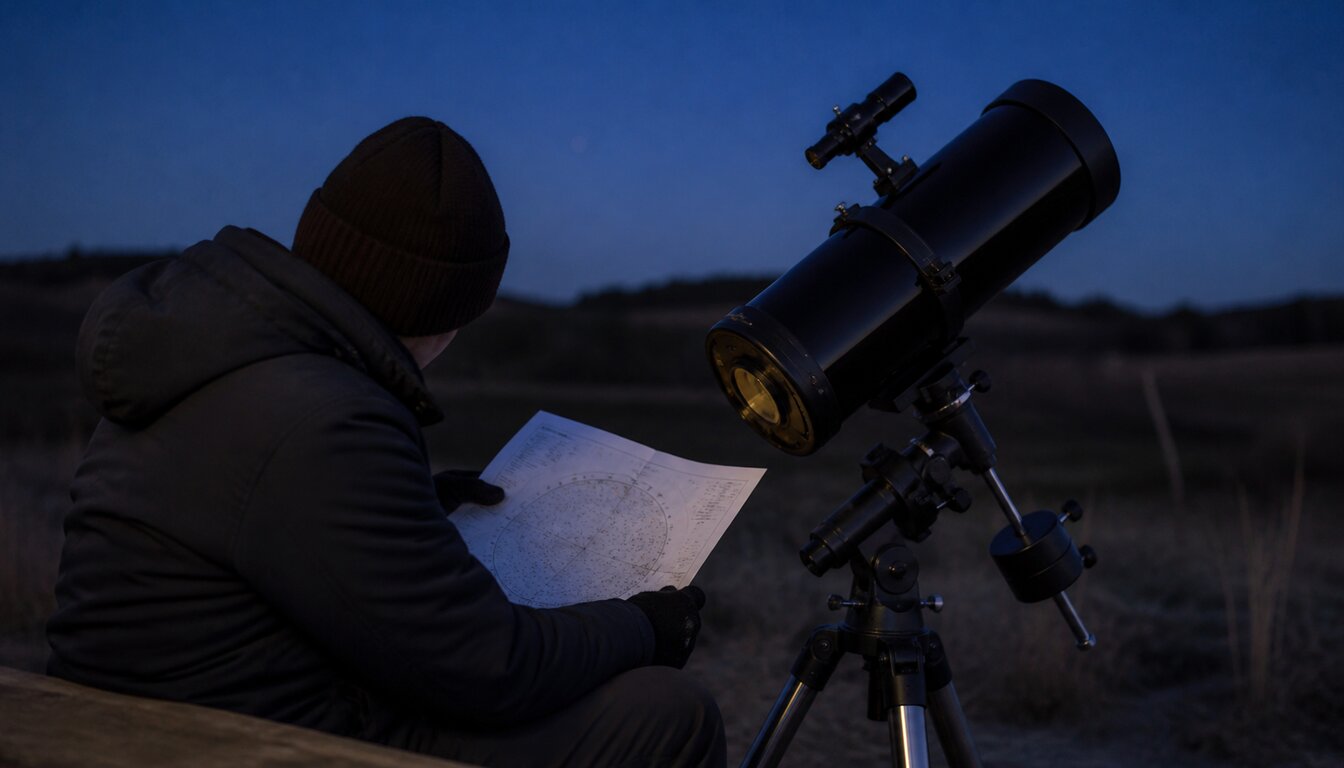
Observing clubs used those channels much as they used a notice board. A star party date, a change of venue, a request for a missing eyepiece cap, a first light report: each was a short text that one member typed and a whole city could read. A club with a single member who owned a computer and a modem could publish a monthly list of what was worth looking at, and a beginner could read it before deciding whether to buy anything at all.
Did Houston have a free community network in the 1990s?
Yes. Houston ran one, and from 1997 it hosted homepages for local nonprofits, which mattered to clubs with no budget for a printed newsletter. The Houston system belongs to the same record as the Cleveland Free-Net and the FreePort software that many of these services ran, and its community pages are the reason a club calendar from that decade can still be read today. The general account of the period is kept in the reference summary of free-nets.
The division of labour is what a modern observer can borrow from the arrangement. The network carried the date, the place and the directions. The club carried the telescope, the judgement about what was worth looking at, and the willingness to say when a night had been wasted.
What the record asks of an observer
Nothing changes about the sky, and something changes about the note. A chart is only as useful as the observation attached to it, so the habit worth keeping from the free-net era is the short written report: instrument, magnification, sky conditions, what was seen and what was not. An observer who keeps that habit in a table rather than in a folder of paper will find the shape of the working record in the shape of the working log. The limits of a field note are set out on the methodology page, and the records used here are listed in the source register.
Source note. Practical context is checked against the primary and specialist records in our source register, then bounded by the methods recorded on the methodology page.